
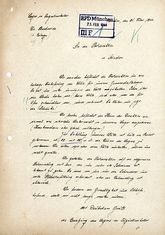
Letter of protest by Czechs, February 1944.
63 Czech laborers employed by the Reich postal service and housed in the Augustinerkeller restaurant submitted a written complaint to their employer about living conditions in the camp.
Source: Staatsarchiv München
More on the subject
Educational offers / Worksheets (in German)
Munich: The Camp Cosmos in a German Metropolis
Starting in March 1944, Ukrainian families were housed in the library of the Deutsches Museum in Munich, where they were guarded by four German men. The Ukrainians were put to work in the municipal administration.
The living quarters of forced laborers varied greatly, depending on the origin of the laborers and how they were classified. They ranged from private quarters to group accommodations in barracks and halls and makeshift camps in factories and barns. Workers from Eastern Europe and the concentration camp inmates were subjected to the worst living conditions. In the large unprotected barrack camps, many forced laborers died during Allied air raids.
As in every German city, Munich featured a dense network of camps. They were plainly visible and an integral part of everyday life for the German population.
Dimensions of Forced Labor
From 1939 to 1945, some 13 million persons were assigned to forced labor in the German Reich and the territories it had annexed (the “Pan-German Reich”). Of that number, some 4.6 million were prisoners of war. The forced laborers came from all of the countries occupied by the Wehrmacht, above all the Soviet Union, Poland and France.
Forced laborers were employed primarily in agriculture, the armament industry, mining and construction. Toward the end of the war, they represented nearly half of the workforce in agriculture, one third in the armament industry and construction, and one quarter in mining. Yet they were quite commonly also put to work in private households and the trades.
Some 2.5 million persons, above all Soviet prisoners of war and concentration camp inmates from all parts of Europe, died as a direct consequence of forced labor in the German Reich.
Munich’s Camp Cosmos
Audio
Wera Iosifowna Wolk about the hygienic conditions in the camp.
Video interview 2005 (voice over, 02:00 min.)
Source: Digitales Archiv “Zwangsarbeit 1939 – 1945”
Maria Andrzejewska, née Kawecka about the conditions at a forced labor camp.
Written reminiscences, 1997 (voice over, 01:45 min.)
Source: Berliner Geschichtswerkstatt e.V.