
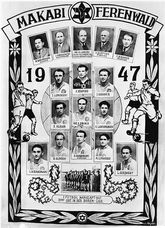
Poster of the Maccabi soccer team of the Föhrenwald DP Camp, 1947.
There were 80 Jewish soccer teams in the DP camps, which played in two leagues from 1947. Maccabi Föhrenwald played in the South league (Yiddish: Dorem-Lige) and took fourth place in the first season.
Source: United States Holocaust Memorial Museum, Washington
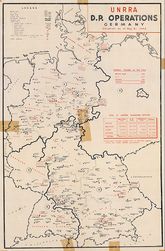
DP camps under UNRRA administration, May 1946.
Until mid-1947, the United Nations Relief and Rehabilitation Administration (UNRRA) managed the DP camps. Afterward they were taken over by the International Refugee Organization (IRO), which attempted to help the approximately 500,000 people still living in the camps to emigrate or to settle in Germany.
Source: Archive of the International Tracing Service, Bad Arolsen

Staff of the Red Cross International Tracing Service at a Name Index, ca. 1960.
In 1948, the Red Cross International Tracing Service took over the task of helping with the search for missing or dead family and friends. The most important aid in this task was the “Central Name Index,“ which contained information on some 17.5 million individuals, including several million former forced laborers.
Source: Archive of the International Tracing Service, Bad Arolsen
More on the subject
The witnesses remember: Zahava S. (section of the exhibition)
Educational offers / Worksheets (in German)
Displaced Persons
The Western Allied occupation powers put those of the former forced laborers who remained in Germany – among them a substantial number of Jews – into “displaced persons” camps, where many waited for a chance to emigrate. Others hoped to succeed in making new lives for themselves in Germany.
It was frequently in former concentration or forced labor camps that “displaced persons” waited for permission to immigrate to the U.S., Canada, Australia or Palestine (and later the newly founded State of Israel). Those who wanted to stay in Germany were regarded by the locals with suspicion. They were viewed as troublesome paupers making unjustified claims.