
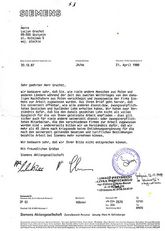
Letter from the Siemens company to Lucjan Gruchot, 21 April 1988.
Siemens refused to provide compensation to Lucjan Gruchot, who had been a forced laborer at the firm. They claimed that what they called “wage supplements” could no longer be paid out 40 years after the war.
Source: Fundacja „Polsko-Niemieckie Pojednanie”, Warszawa.
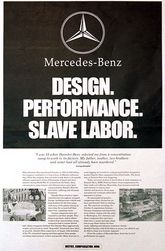
Advertisement in the New York Times, October 1999.
This and similar advertisement in US newspapers protested the sluggish pace of negotiations on the compensation of former forced laborers. The advertisements were placed by various organizations, including the Jewish service organization B’nai B’rith.
Source: ullstein bild (Reuters)
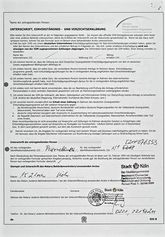
“Waiver declarations” in the applications for compensation, 2001 to 2003.
The regulations for compensation to former forced laborers stipulated that the applicant had to waive all further legal claims against Germany, Austria, and companies of both nations. Anyone who refused to sign the waiver received no payment.
Source: Foundation “Remembrance, Responsibility and Future”
More on the subject
Industry without responsibility? (section of the exhibition)
Conflict over Remembrance
In 1960, the German War Graves Commission established a cemetery at the Arnsburg abbey in which German soldiers, members of the SS, and foreign prisoners of war and forced laborers were buried. The latter group included the remains of the 87 victims of the mass murder at Hirzenhain. Even though members of the commission were aware of their names and the circumstances surrounding their death, they were buried as “unknown war dead.” This was not corrected until the mid-1990s.
The Ukrainian forced laborer Alexandra Tubikha was killed in the final days of the war in Wippenbach (Hessen). The village residents at first hid her body in a dump ground and then buried her in the village cemetery. Later Alexandra Tubikha’s grave was recorded as “missing.” Today nothing in the village commemorates her fate.
In the 1970s, however, the idea that the problem had been solved once and for all began to provoke protest. Frequently it was local initiatives which investigated specific local histories and demanded that assistance be given to those former forced laborers still living. Growing knowledge about the crimes which had been committed went hand in hand with public pressure to think about compensation.
“The manner in which we rendered compensation often manifested the opposite of what compensation is supposed to be: [We] turned the victims of persecution into beggars, people who missed deadlines, people unworthy of trust, and finally, people unworthy of compensation.”
Dörte von Westernhagen, writer and journalist, in the weekly newspaper “Die Zeit”, 5 October 1984.
The Long Road to Recognition
There was no discussion of forced labor in the immediate post-war period. Former forced laborers wanted their fates acknowledged and to be redressed,
but for the most part their demands fell on deaf ears.
Only since the 1970s in Germany and the 1980s in Austria have citizens’ action groups begun to call for the history of forced labor to be remembered.
Yet it was not until sixty years after the war’s end – and only after former forced laborers had brought classaction suits against German and Austrian companies
in the U. S. – that the state and private enterprise were prepared to acknowledge the injustice that had been perpetrated. German firms, at least, were threatened with the loss of prestige. To secure their legal position and in response to increasing public pressure, the governments and companies in both states financed foundations, the Foundation “Remembrance, Responsibility and Future” in Germany and the “Reconciliation- Fund” in Austria, whose purpose was to make humanitarian payments to former forced laborers.
“For all those who lost their lives back then, the compensation comes just as much too late as for all who have died in the meantime.”
Federal German President Johannes Rau, 17 December 1999.